Showing posts with label arts. Show all posts

Saturday, November 10, 2012

Chasing Leprechauns

In the end, the one thing that really defines our trip to Ireland -- more than castles, ancient druid sites, pubs, or sheep -- is hunting leprechauns. When she was around four, Gigi used to construct elaborate leprechaun traps at our house in the States. Now she's old enough to laugh at the futility of that, and seven-year old Pippa joins in since she sees the humor in trying to trap leprechauns in San Francisco. Now that we're in Ireland, though, all bets are off, and throughout most of the trip Pippa is convinced she will capture one.
 
 
Our first close encounter with a leprechaun is on our hike in Connemara. On the road, Pippa is convinced she sees a flash of a tiny white leprechaun shirt as we drive quickly by. Then, on the hike, we see off in the distance the tip of a hat running away from us. I see the tip of the hat, too, and it does look extra tiny because the child wearing it is on a sunken path. I say child, but could it be a leprechaun? Pippa is convinced that's what we've seen, and she checks out all the likely secret hiding spots for one of their homes. She is a detective, hunting for clues: the inside of this bush looks recently disturbed. They've been here and run away when they heard us coming!


Between hunting for leprechauns and a strange "Gangnam Style" dancing game that Anthony invented, the girls are cracking up for most of the hike.


It's hard not to believe in leprechauns when we see something like 15 rainbows over the course of our trip (literally, we stopped counting).


One day we see the most glorious rainbow and can't help but chase after it. We pull off the road, into a private drive, where we see the end of the rainbow clearly landing in the middle of a farmer's cow field. Admit it: You see it, too, and you know the pot of gold is just behind the ridge. So we do what any sane American leprechaun hunters would do, and we climb over the fence and chase after it.

But of course where this is a rainbow there has been, recently, rain. And where there is a cow field, there has been, recently, a herd of cows. Together that makes for some very squelchy, squishy, mucky walking. We just can't get to the end of the rainbow, especially since that pesky end just keeps moving further and further into the field the closer we get.


After we begrudgingly admit we can slog no further, Pippa bursts into tears, and we have to console her. Uh-oh. Perhaps we've gone too far. We have to start on a new campaign of talking about how much leprechauns hate being found. They're hard to catch, those wily, tricky, mischevious leprechauns! According to Pippa, that means we may just be the most successful leprechaun hunters around -- having seen their home and hat and all. According to me, we already found the pot of gold: It's the memory of trespassing in this farmer's field, chasing through the mud and muck after the end of the rainbow on an impromptu family adventure while the cows look on, bemused.


This is important enough to us that we make a pilgrimage to the National Leprechaun Museum in Dublin where we learn interesting factoids, like that leprechauns are originally Scottish. And that they used to wear brown coats and red hats, and the point was to steal the hat in order to get the pot of gold. Credit for the current image of the leprechaun -- with green clothes and red beard, slightly mischevious but not downright nasty, guarding his pot of the gold at the end of the rainbow -- goes to...... Lucky Charms and Disney. Yes, really. They are magically delicious! The king of the leprechauns in Walt Disney's film, Darby O'Gill and the Little People set the standard in America for their current look, and it was the film and Lucky Charms that brought that image back to Ireland.
 
 
And so we say good-bye to Ireland. Pippa writes a song about the trip, with a little help from me and her guitar teacher, that pretty much sums it up perfectly (Her spelling in italics. Translation follows):
 
We sreached for lepercon's on the maintins. In the wilooold's of Kanamra.
We searched for leprechauns on the mountains, in the wilds of Connemara.
We sreached for lepercon's in the cow feld's at the end of the ranbo.
We searched for leprechauns in the cow fields at the end of the rainbow.
 
We hunted hi and low.                                                               We hunted high and low.
Wer did they all go?                                                                  Where did they all go?
I gost d'ont no.                                                                           I just don't know.
 
We sreached for lepercons by the clear strem's in the would's of Klarni.
We searched for leprechauns by the clear streams in the woods of Killarney.
We sreached in the fairy glades and gardin's at the castole of blarni.
We searched in the fairy glades and gardens at the castle of Blarney.
 
We hunted hot and cold                                                              We hunted hot and cold
For that pot of gold.                                                                     For that pot of gold.
We hunted hi and low,                                                                 We hunted high and low,
Wer did they all go?                                                                    Where did they all go?
I gost d'ont no.                                                                             I just don't know...


Tuesday, November 6, 2012

Home on the Grange

Earlier this week, in county Limerick, we detoured to see the Lough Gur settlement, which includes the roughly 4,000 year-old Grange stone circle, the largest stone circle in Ireland. It has 113 standing stones set in a diameter of 45 meters/ 150 feet, aligned with the summer solstice. Stonehenge, for comparison, is "only" 33 meters in diameter with 30 stones (17 still standing).

I can't honestly say Lough Gur is more impressive than England's Stonehenge, mind you. But this one has its own charms namely: that it is filled with grazing cows; and also that the person who mans the entrance lives across the street and saunters over once he sees us there. There are no tickets per se, so we give him a euro for a somewhat blurry summer solstice postcard to support the site. He proudly shows us a 30-year old book on the Children of Ireland, in which his own kids are featured playing in this very circle.

 
If you do play inside or near the stone circle, beware! Look carefully; one of these is not a stepping stone, but rather a squared-out cow patty.
 

From Grange to Newgrange which is, despite the name, not very new at all. We head about an hour north of Dublin in County Meath to see the Newgrange stone-age passage tomb. This one dates from around 3,200 BC which makes it over 5,000 years old and older than the Pyramids (Egyptian, Mayan, Aztec or other), Stonehenge, the Great Wall of China, the Wailing Wall in Jerusalem, and basically every other old man-made thing you can think of.
 

Newgrange is a burial mound, with a winter solstice phenomenon where the light passes through the upper window in a precise line to illuminate the interior. They still bring people in to see the solstice, if the weather cooperates (has to be sunny for the sun to shine...). But since there are about 2700 applications for 100 spots over the five days centered around the solstice, you're unlikely to see it then. But even on a random Tuesday, between the re-enacted solstice lighting and the stone construction itself (only the outside of which has had to be reconstructed), it's quite impressive -- much more impressive than expected.
 
 
The entire site is very mysterious, with lots of theories but very little actually known about the exact purpose or meaning of anything. What are the swirls carved into the giant boulders? Nobody knows for sure. But the theories, like the site itself -- and like my husband -- can be way out.


Tuesday, October 30, 2012

Closed for the Season

One of the greatest joys of traveling is the unexpected discovery. And what we discover is that, most apologetically, Ireland is closed. The country was, apparently, open until some vague, unnamed timed earlier this month, with the occasional petting zoo (yes, we're talking to you Newgrange Farm) taking vacation as early as September.

My Irish friend Brendan says, "It takes a brave sort of person to visit Ireland in the wintertime." But what he doesn't take into account is the following:

1) We might not be brave but, instead, just plain stupid.
2) We figured, if it was going to be rainy and cold, we might as well go someplace that is supposed to be rainy and cold and can be enjoyed that way (hello, cozy pub!). As opposed to Italy, or Spain, for example.
3) Many of Ireland's tourist sites are actually somewhat enjoyable from the outside. It gets to a certain point where we don't really need to visit the inside of another castle or church.
4) And at least this means we have no lines, and no crowds, anywhere -- even at the most touristy of spots. The ones that are open, I mean.

So, here's a partial list of things we do not get to see while in Ireland:

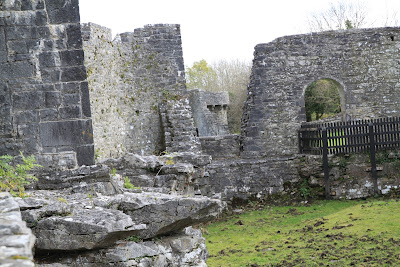
Though Aughnanure Castle, which is our first stop on a day of touring Connemara, is closed, I want to climb into it anyway. You can see by the photo that it would be easy enough to scramble through the gaps in the ruined 16th century walls. I would like to say that I am held back by common sense, or by the desire to set a good example for our children. But, in fact, I am only held back by my husband's common sense and desire to set a good example for our children, and I, personally, regret not breaking and entering.


Consolation prize: cute puppies in the parking lot.


What is open later this same day is the 19th century Kylemore Abbey. But I wish that it were closed. We are using a Lonely Planet guidebook from 1996 -- the same one I used when I visited Ireland about 15 years ago -- as a rough guide. I didn't get to see the Abbey the last time, because it was an exclusive convent boarding school. Well, now it's open to the public, and open year-round, unfortunately. It is shockingly expensive (in fact, it will turn out to be the single most expensive admission fee we pay, at 25€ for the family). And as impressive as it is from the outside, the inside is really just not worth it. The best part of the place is this view and the excellent café, both of which come before the ticket counter, so no need to pay.


Another day, at the Dunguaire Castle, we see the people milling about the outside, craning their necks upwards, and we know it's closed without even seeing the "Sorry..." sign on the door. Luckily, at this point we are on our way to the Cliffs of Moher, and we are optimistic that it's difficult to close a cliff.

 
And finally, on another day, we head down toward Ennis where we are all disappointed not to be able to go into the Craggaunowen Project, which is a sort of re-created prehistoric village. This is the closed place we most wish we could see. Then we head to the also-closed Knappogue Castle, pictured below. By now, it is starting to feel a little like our Dismayland Paris experience. But with more driving.


So we are relieved when we get to Quin Abbey, which is open, even though it's not a major tourist destination and not, probably something we would have bothered to go see. Still, it's open! And why? Mostly because it's a currently used cemetery. It's a partial ruin from the 15th century, with some of the walls from a previous 13th century castle, and it's charming enough. Nevertheless, we hightail it over to the Dromoland Hotel, which is a 5-star hotel and golf resort, to treat ourselves to a very fancy lunch. And it's open (thank goodness).


On the way home, our last stop for the day is the W.B. Yeats tower. It is, of course, closed.


The engraved stone on the outside of the tower -- the only side we get to see -- says:

I the poet William yeats
With old millboards and sea-green slates
And smithy work from the Gort forge
Restored this tower for my wife George.
And may these characters remain
When all is ruin once again.


Monday, October 29, 2012

Mead and Mess

Bunratty Castle, Caisleán Bhun Raithe, in County Clare near Limerick, feels both authentic and totally Disneyfied at the same time. This is not a complaint, mind you. It's actually quite a pleasant combination. Here's a place that screams "medieval!" and "country!" yet simultaneously "clean!" and "not smelly!" The current structure is basically a 15th century castle, though it was built, burned, rebuilt, razed, rebuilt, and attacked for about 500 years before that. I'm perfectly happy to miss that particular period of authenticity.


Bringing the medieval Irish authenticity barometer down a notch today is the fact that Bunratty is dressed up for a Halloween celebration. I don't know if the Bobby and old-timey guy in front of the J.J. Corry tabacco shop would always be dressed that way. But, given the quaintness of the folk village that lies in the shadow of the castle, it's a distinct possibility.


The highlight of Bunratty for us is the medieval dinner, with period music. Pippa can not believe that we are really going to eat dinner in a castle. Until we actually sit down, she is convinced I am pulling her leg. It turns out that even though there are very few children at the dinner, I think we're the ones who've planned it perfectly. It's a great thing to do with kids this age. They are in hysterics when one of the other guests gets thrown into the dungeon and has to sing his way back to the Lord and Lady's good graces. They even request a visit to the dungeon themselves. They are at that magical age and will believe almost anything, and they really feel like they've gone back in time. A time when busty wenches served ribs that hinted of Southwestern US BBQ followed by fluffy, refrigerated  blancmange desserts.

Along with the live period music, one of the best parts is that forks were not a regular part of dining until one or two hundred years later than the castle's 15th century theme. So the kids get to rip into the chicken and vegetables (as well as the more normal finger foods like ribs and bread) with their hands. In keeping with the times, they are also allowed to stab their food and eat off their knives. So they're not complaining about any small historical anomolies. Look, who am I to gripe about anachronisms, when we bring our daughters to a medieval dinner dressed as a gypsy and a leopard?


And of course, this being a medieval meal, instead of Guinness or even wine, we have honey mead. This is such a Bunratty medieval dinner tradition that later, when we are in Dublin at a pizza restaurant and the waitress walks up just in time to hear the single word "mead", she immediately asks, "So, did you eat at Bunratty, then?" It's honey wine and so sweet, even my high-school, Bartles-&-James-wine-cooler-loving self would have been happy to down a ceramic mug of it. Here's my honey, drinking the honey.


Despite the festivities today, the kids are counting down the days till the real holiday. More on Halloween, well, on Halloween.

Sunday, October 28, 2012

The Art of Guinness

At the Guinness Storehouse in Dublin, we are taught the art of pouring a perfect Guinness:

1) Tilt the glass away from yourself at a slight angle, then pull the handle towards yourself, to aerate. Slowly straighten the glass while pouring, stopping when it reaches midway up the harp icon.
2) Let it sit several minutes and watch it turn from brown to black, as the bubbles settle.
3) Push the handle away from yourself to top it off, till the foam arcs above the top of the glass.

And there you have it. You can take me word for it; I must be an expert, because I have the certificate declaring that I can pour a perfect pint (certificate requirement: steep admission fee and approximately eight minutes of training).


The irony, of course, is that as soon as I pour the perfect pint, I give it to somebody else who might actually want to drink it. Not me. I can't stand the stuff. Too bitter, too bubbly. Before you gouge your eyes out with the high level of sacrilege you've just read, I would like to throw my Irish friend Brendan under the bus by telling you he's allergic to Guinness (and wool, too! Oh, the irony!).

The Storehouse used to be the actual place Guinness was manufactured along with a little tour and tasting room. Since my last visit here about 15 years ago, it has transformed into a full-on, state-of-the-art, extremely well-oiled tourist machine. But a fun one, nevertheless. Besides learning about the history of Guinness (including the factoid that the lease on the building is for 9,000 years), how it is made, and how to pour the perfect pint, there's also a bar upstairs with a 360° view of Dublin that can't be beat. Here you are at the top of what is billed as "the world's largest pint glass", since the building is now shaped like one. However, wouldn't a pint glass, by definition, always be the same size? You can ponder that while you head back down to the bottom of the glass, er, building, where there's an extensive gift store that sells, among other things, Guinness-infused chocolate truffles. Speaking from experience, we do not recommend these.


In one perfect village pub, the girls try on Guinness mustaches. That's as close as they want to get.


Despite not drinking Guinness, I am a huge fan, particularly because of the colorful advertising found all around the countryside. Basically, I love being all cozy in a pub with somebody else ordering a Guinness.